 Scott Sistek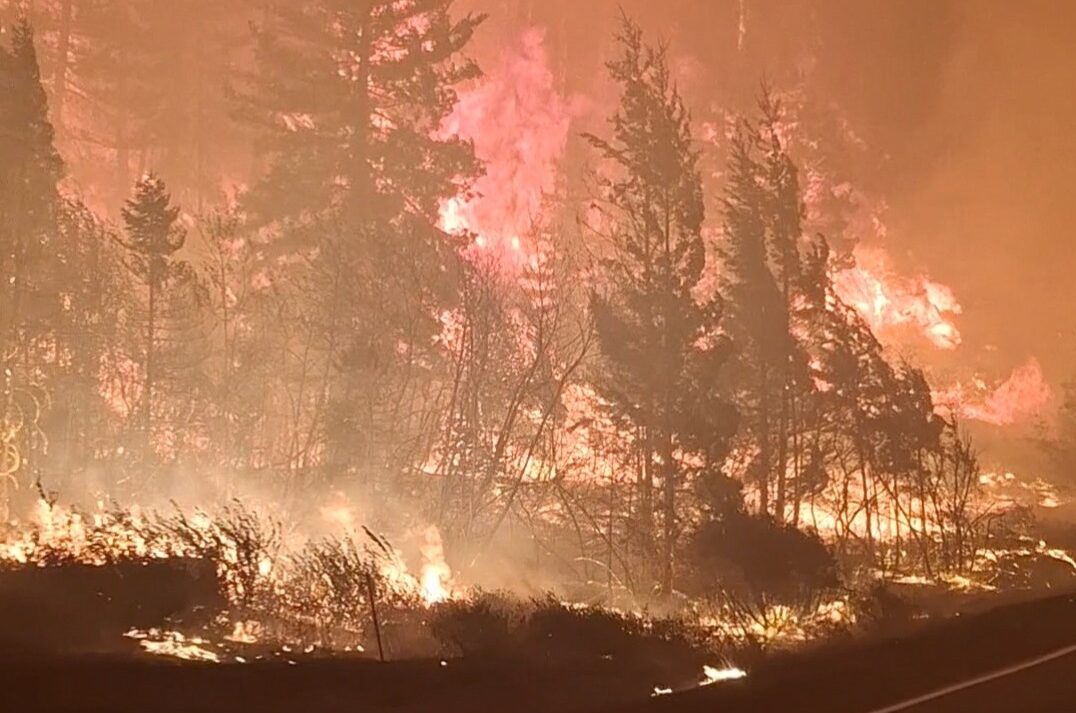
Labor Mountain Fire in he Washington Cascades. (Photo courtesy: WSDOT)
Earlier this summer, wildfire officials said lightning from a thunderstorm that rolled over the Northern Cascades started the “Arctic Fire”.
Any guesses where it was burning? Alaska? Canada? Did Rudolph leave the S’mores on the fire pit too long?
It was in northern Whatcom County.
What? I mean winter Fraser Wind storms make it feel like the arctic sometimes, but in September?
Wildfires are a rite of passage every summer but have you ever wondered how they get their (sometimes puzzling) names? Blame geography.
Unlike, say, hurricanes or European storms which have a pre-set list of names agreed upon by large committees, wildfire names are more of the, ahem, Wild West. They are usually at the discretion of the responding fire unit, or incident commander or even the dispatch center where the fire began. (2)
A vast majority of the time, the fire name references a nearby landmark, street or geographical feature that can give local firefighters some direction of where the fire began. In the Arctic Fire sense, I’ll bet there was like an Arctic Road or “Arctic Hill” nearby (UPDATE: Thank you to Eric Allen, who had the answer: “The Arctic Fire is between a couple avalanche chutes that feed into Arctic Creek.”)
OMG THERE WAS A TORNADO FIRE IN CALIFORNIA?
One of my wishes as a journalist though is for those naming the fire to try to write a headline based on what they’re thinking of naming fire and see what happens.
It’s been a little pet project of mine to jot down some of the more, shall we say, journalistically challenging names I’ve run across over the past few months. I swear these were real fire names given around the country:
- Tornado Fire (Not a burning tornado; it was burning along Tornado Drive)
- Snowstorm Fire (…how?)
- Dinky Fire (let’s hope so!)
- Horse Fire (They’re OK!)
- Serendipity Fire (Seems an oxymoron)
- Bonanza Fire (again?…)
- Texas Ferry Fire (Not in Texas nor a burning ferry — and it was near Spokane?)
- Jacket Fire (Seems like it’d be easy to douse)
- Good Fire (Maybe a Charmander fan?)
- Grizzly Fire (They’re OK!)
- Motel Fire / Inn Fire (They’re OK! I think…)
- Wolf Fire (They’re OK!)
- Turkey Fire (They’re OK!)
- Lemon Fire (They’re… probably OK?)
- Studhorse Fire (They’re OK!)
In 2022, we had the “Bogus Fire” that was real (near Little Bogus Creek Road), the “Dinosaur Fire” (They’re…not OK! But it was a different fire…) and the “Airline Fire” that thankfully wasn’t aviation related but was just burning near the “Airline Highway”.
But you end up with headlines like: “Texas Ferry Fire expands near Spokane” or “Motel Fire causes evacuations in California” — the capital ‘F’ in fire is your clinging hope for comprehension 
Ironically there *have* also been tornado fires (lowercase) recently — officially known as fire whirls. That’s when the fires run so hot in an unstable atmosphere with twisting winds they can create their own tornados. There was just one in Utah earlier this summer that rated an EF-2, and of course the monster EF-3 fire tornado that hit Northern California during the Carr Fire — not “car” fire but… you get what I mean.
So next time you hear a new fire name, that’s how it got it.