 Scott Sistek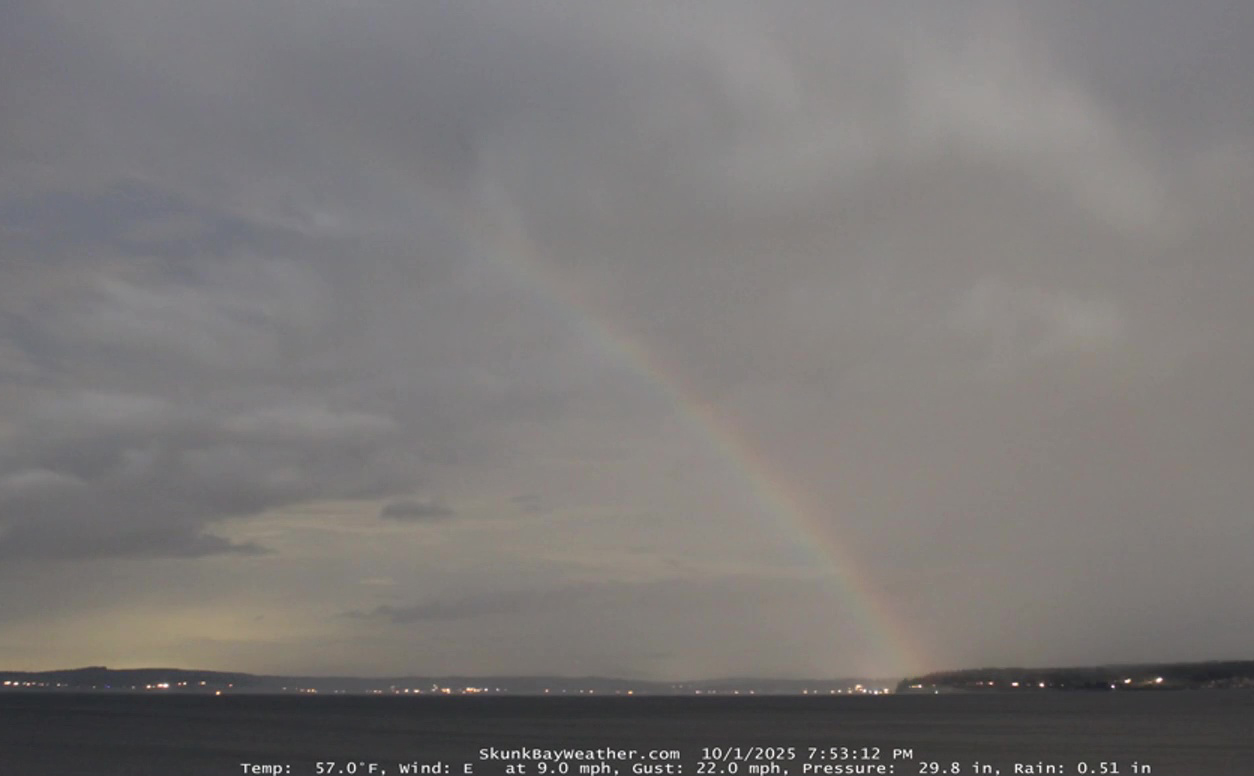
Moon bow in Hansville on Oct. 1, 2025. (Photo: SkunkBayWeather.com)
Cory Hart wrote a song about wearing his sunglasses at night. More metaphorical than literal need, but last week even after the sun had set, it was still bright enough to make a rainbow.
Huh?
The photo of the rainbow above was taken from Greg Johnson’s awesome SkunkBayWeather.com camera from his waterfront perch looking north across Puget Sound in Kitsap County’s Hansville.
At first glance, it may seem ordinary, until you realize it’s a bit dark in the picture. Further investigation reveals his time stamp shows the photo was taken just before 8 p.m.! The sun had set about 90 minutes earlier — it was actually dark!
So, where did the rainbow come from? The moon!
The moon was nearly full that night, and it rose just before 5 p.m., so it was still relatively low on the horizon. But it was still a bright enough source of light and the rain was just in the right spot to still trigger the light refraction process to create a rainbow — or in this case, it’s called a “moon bow”.
DID YOU KNOW…
Rainbows (and moonbows) are formed when sunlight (or, in the case, moonlight) gets slightly refracted at a 42 degree angle when it encounters a raindrop, but each color wavelength gets bent at slightly different angles, spreading out the colors into the stacked arc we see as a bow, but it’s really a full circle arc. Just part of the circle is “hidden” by the ground — you usually only see the top part.
But this lends to one of my favorite weather questions to stump your friends: Did you know in Seattle, you’ll never see a rainbow at lunch during the summer?
For the rainbow to be visible as an arc on the horizon, the sun must be lower than 42 degrees above the horizon. The lower the sun angle, the larger the rainbow arc will appear. The BEST and most dramatic rainbows on the horizon occur in the hour so before sunset or after sunrise when the sun is just above the horizon.
The rainbow will get shorter and shorter as the sun climbs, until the sun reaches 42 degrees at which point the “rainbow” would be all on the ground and not visible as an arc in the sky. (If you were, say on a mountaintop ridge at Snoqualmie though and could look below your ground level, you could see the rainbow arc below you.)
For Seattle, this magic date when the sun climbs above 42 degrees during the day happens to coincide with the equinox dates — March 20 and Sept. 22. That means during spring and summer, when the sun is at its peak height during the day, it will be too high in the sky to make a rainbow. It’s only briefly that high in early spring and late autumn, but around the summer solstice, it’s nearly all day!
On the first day of summer, there are no rainbows possible in Seattle between 9:40 a.m. (PDT) and 4:40 p.m. as the sun is too high. Stump a friend! (And then send them a link here 🙂 )